
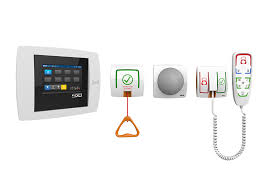
A Nurse Call System is a critical communication
and emergency response system used in hospitals, nursing homes, and elderly
care facilities. It allows patients to summon assistance from nursing staff and
enables staff to communicate effectively with each other.
In modern facilities, the Nurse Call System is
an intelligent **ELV (Extra Low Voltage)** system that integrates with ICT,
Audio, and Wireless networks.
Here is a detailed breakdown of the system.
1. Core Purpose
Patient Safety: Immediate alerting for emergencies (falls,
cardiac distress).
Operational Efficiency: Routing calls to the correct staff member
(e.g., calling a specific nurse rather than a general alert).
Staff Safety: "Staff Attack" or "Duress"
alarms for workers in volatile situations.
Data Logging: Recording response times for regulatory
compliance and quality assurance.
2. Key Components
The system consists of hardware located at the
patient's bedside, the staff station, and the corridors.
A. Patient End Units
Bedhead Unit (BHU): A panel mounted at the
bedside containing the controls.
Call Cord/Pear Push: A handheld button plugged
into the wall (within reach of the patient) to initiate a call.
Pillow Speaker: Allows the patient to listen to
the TV/Radio and adjust volume without getting up.
Handheld Pendent (Wireless): Worn around the
neck (like a lanyard) allowing the patient to trigger an alarm even if they are
in the bathroom or away from the bed.
Bathroom Pull Cord: A water-proof pull switch in
bathrooms/emergency showers for falls in wet areas.
B. Staff End Units
Nurse Console (Master Station):Usually a screen
(touch LCD) at the nurse's station showing a floor plan of the ward, list of
active calls, and patient details.
Corridor Dome/Lights: Visual indicators (usually
mounted above the door) that flash or display colors (Amber for normal, Red for
emergency) so staff can see calls from down the hall.
Staff Badge/Wrist Tag: Wireless devices worn by
nurses that receive calls and location data.
Wall-Mount Staff Stations: Secondary displays in
medicine rooms or utility areas.
C. Infrastructure
Server/Controller: The central brain managing
the signals.
Expansion Modules: Hardware to interface with
door mag-locks, fire panels, or PA systems.
3. Types of Nurse Call Systems
A. Wired Systems
Technology: Uses physical cabling (usually star
topology cabling or bus wiring) to connect every bed to the control panel.
Pros: Highly reliable; no battery dependency for
patient units; lower latency.
Cons: Difficult and expensive to retrofit in
existing buildings; requires heavy civil work (chasing walls).
B. Wireless Systems
Technology: Uses radio frequency (RF) or Wi-Fi
to connect devices.
Pros: Very easy to install in old buildings (no
drilling); devices are portable (beds can be moved).
Cons: Devices require regular battery charging;
risk of signal interference (dead zones).
C. IP-Based Systems (VoIP)
Technology: Runs over the hospital's existing IT
network (CAT6 cabling and switches).
Pros: Scalable; integrates easily with mobile
phones/DECT handsets; allows remote monitoring via internet.
Cons: Dependent on the network infrastructure;
requires IT security management.
4. Operational Features & Logic
A modern system is not just a buzzer; it uses
priority logic:
|
Priority |
Call Type |
Visual (Dome Light) |
Audio (Sound) |
Staff Response Required |
|
Routine |
Patient asks for water/pillow. |
Flashing Amber/Yellow |
Chime (Polite tone). |
Normal priority. |
|
Emergency: |
Patient pushes "Code Blue" or
distress. |
Solid Red
|
Continuous. Loud Alarm |
Immediate - All staff rush. |
|
Staff Attended: |
Nurse enters the room (plugs in badge). |
Light stays On (to show busy). |
Muted. |
Staff working in room.
|
|
Staff Duress |
Nurse pulls cord/presses badge under threat. | |
Flashing **Red**.
|
Fast/Aggressive Alarm.
|
Security team alert.
|
Advanced Features:
Baby Monitoring: In maternity wards, the nurse
call can link to baby movement sensors.
Automated Escalation: If a routine call is not
answered within 3 minutes, the system automatically escalates the call to the
Supervisor’s mobile or the Nurse-in-Charge.
Paging: Integration with DECT phones or pagers
so nurses are not tied to the desk.
5. Integration with Other Systems
(ICT/ELV)
The Nurse Call system is a central hub for
hospital automation:
1. Integration with CCTV.
Scenario: A "Staff
Attack" alarm is triggered.
Action: The system sends a trigger
to the nearest CCTV camera to start recording or pop the feed onto the security
monitor.
2. Integration with Access Control
Scenario: Code Blue (Cardiac
Arrest) in the ICU.
Action: The Nurse Call system unlocks the ICU
magnetic doors automatically to let the crash cart team enter without fumbling
for keys/cards.
3. Integration with PA/VA System.
Scenario: Emergency Evacuation.
Action:The Nurse Call system can
mute the background music and broadcast a pre-recorded evacuation message.
4. Integration with BMS (Building
Management).
Action: Tracks "Bed Occupancy." If a
bed is "Cleaned" and marked "Ready" on the Nurse Call
panel, it can update the BMS to adjust the airflow in that specific room.
6. Maintenance & AMC Scope (Technical)
Maintaining a Nurse Call system is critical for
patient life safety.
Routine Preventive Maintenance (PM)
Patient Unit testing: pressing every call button
to ensure the signal reaches the nurse console.
Bathroom Cord Testing: Pulling the emergency
cords to verify they trigger an alarm.
Battery Checks: Testing backup batteries (for
central units) and charging cycles for wireless staff tags.
Cleaning: Disinfecting call buttons and pillow speakers
(critical for infection control).
Software Health Check: Verifying that the call
logs are recording properly and response times are being calculated.
Breakdown Maintenance
* Fixing dead spots (where calls
don't register).
* Replacing water-damaged units in
bathrooms.
* Repairing broken call cords or
lanyards.
Summary
The Nurse Call System is the lifeline of a
hospital ward. It has evolved from simple buzzers to intelligent, IP-based
communication platforms that track staff efficiency and integrate tightly with
security and IT infrastructure to save lives.

AL BAYT 7 Tower Ground Floor Unit 3, P, Box: 12613
King Faisal bin Abdulaziz Al Saud Road Al Murabba Riyadh KSA.
Branches
Tadban/Hyderabad India,
2501 CHATHAM RD STE R SPRINGFIELD IL 62704 USA,
As Sawmhan / Barka / South Al Batinah Governorate Oman.

0535398660
0561657087
0115126975

Saturday -Thursday (9:00 AM - 6:00 PM)
Friday: Off