
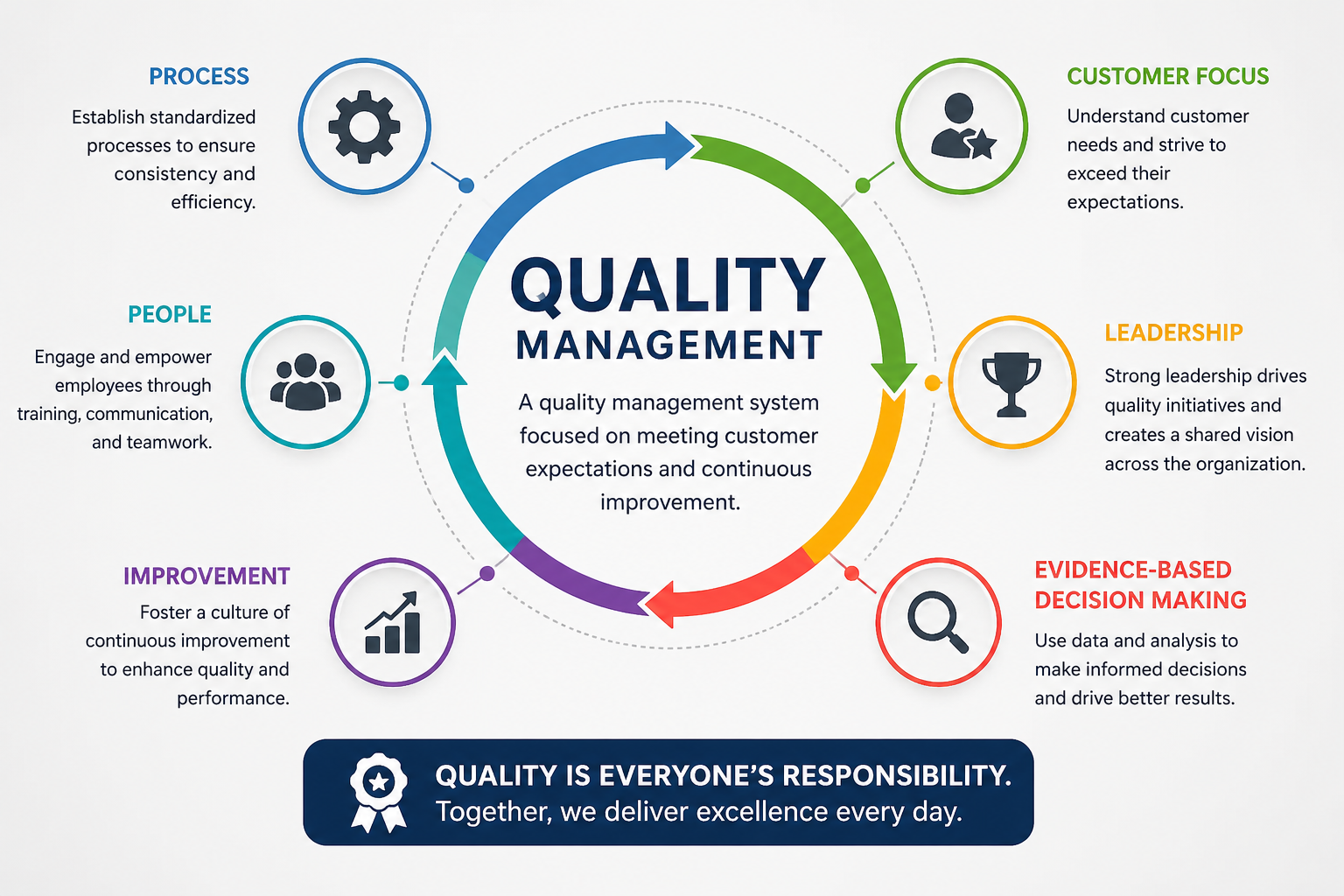
Here is a detailed
breakdown of Quality Management systems, processes, and tools.
1. Core
Concepts: QA vs. QC
It is crucial to
understand the difference between these two pillars of QM.
Feature | Quality Assurance (QA) | Quality
Control (QC) |
Focus Process. Preventing
defects. Product. Detecting defects.
Orientation Proactive
(Planning). | Reactive (Inspection/Testing).
Goal to ensure the
method of work is correct. To ensure the result of work is correct.
Example (MEP)
Reviewing the installation procedure for a Chiller pipe. | Pressure testing the
pipe to check for leaks.
Example (ICT)
Establishing a standard for cable labeling. | Checking if the label on the
cable is actually readable. |
2. The Quality
Management Framework (ISO)
Most professional
organizations follow the **ISO 9001:2015 standard. This framework is based on
the PDCA Cycle (Plan-Do-Check-Act).
1. Plan: Define
objectives and processes to achieve results (e.g., "Achieve 99% server
uptime").
2. Do: Implement
the processes (e.g., Install servers, train staff).
3. Check:
Monitor and measure processes against policies (e.g., Audit logs, check
uptime).
4. Act: Take
actions to continually improve performance (e.g., Change procedure if downtime
occurs).
3. QM in Construction
& MEP Projects
During the
installation phase, Quality Management is document-heavy and inspection-driven.
A. Material Control
Approval of Materials:
No material is bought without the consultant/client approving a sample
(Material Submittal).
Inspection
Certificates: Ensuring steel, cables, and pipes have valid test certificates
from the manufacturer (Mill Test Certificates).
B. Inspection Test
Plans (ITP)
An ITP is a document
that defines *when* and *how* inspections happen.
Hold Points: Stages
where work must stop until an inspector signs off (e.g., concealing conduit
inside a wall).
Witness Points:Stages
where the client *may* choose to watch the test.
C. Common Tests
MEP:
*Pressure
Test:* Pumping water/air into pipes at 1.5x working pressure to check for
leaks.
*Flushing:* Cleaning pipes to remove
debris.
*Air Balancing:* Adjusting dampers to
ensure airflow matches the design.
ICT:
*Continuity
Test:* Checking if copper wires are unbroken.
*OTDR/Fluke
Test:* Checking fiber optic light loss and copper cable performance (Cat6
certification).
Civil:
Slump
Test: Checking concrete consistency before pouring.
Rebound
Hammer Test: Checking hardened concrete strength.
4. QM in
Operations & Maintenance (AMC)
In the maintenance
phase, Quality Management shifts from physical construction to **Service Delivery
and Performance Metrics.
A. Service Level
Agreements (SLA)
The contract defines
quality metrics. The QM team measures compliance against these.
Response Time: Did a
technician arrive within 2 hours?
Resolution Time: Was
the AC fixed before the next business day?
Uptime: Was the server
available 99.9% of the month?
B. Standard Operating
Procedures (SOPs)
Quality is ensuring
everyone follows the same script.
Example: An SOP for
"Chiller Startup" dictates that the mechanic must check oil levels,
then refrigerant pressure, then water valves, in a specific order.
.
5. Tools for Quality
Improvement
When things go wrong
(breakdowns, leaks, system failures), QM uses tools to find the root cause and
fix it forever.
A. Root Cause
Analysis (RCA)
6 Whys: Asking
"Why?" five times to get to the bottom of a problem.
Problem:Server
overheated.
Why 1 AC
failed.
Why 2 Compressor tripped.
Why 3 Motor
overheated.
Why 4 Fan
belt broke.
Why 5Preventive
Maintenance checklist missed the belt tension check.
Fix:
Update the PM checklist to include belt tension.
B. Fishbone Diagram
(Ishikawa)
Brainstorming causes
under: Man, Machine, Material, Method, Environment, Measurement.
C. Six Sigma
A data-driven approach
to reduce defects (aiming for 3.4 defects per million opportunities).
DMAIC: Define,
Measure, Analyze, Improve, Control.
D. Corrective and
Preventive Actions (CAPA)
Corrective Action:
Fixing the immediate problem (e.g., fixing the broken belt).
Preventive Action:
Changing the system to ensure it never happens again (e.g., buying better
quality belts).
7. Quality Checklists
(Examples)
Checklists are the
frontline tools of QC.
Example:
Civil/MEP Handover Checklist
Area is clean and free
of debris.
Ceiling tiles are
aligned and clean.
Thermostats are
calibrated (set to 24°C).
Leak detectors are
functional.
Labeling is present on
all panels (as per naming convention).
Example: ICT
Network Maintenance Checklist
Rack cabinets are
locked.
Fiber patch cords are
not bent below radius limit.
UPS temperature is
within range (20-25°C).
Log files are
downloaded from switches.
Summary
Quality Management is
the glue that holds technical projects together.
Without QA: You waste
money doing things wrong and re-doing them.
Without QC: You
deliver a finished product that fails, leaks, or crashes.
With QM: You deliver a building or service that is
safe, reliable, and professional.

AL BAYT 7 Tower Ground Floor Unit 3, P, Box: 12613
King Faisal bin Abdulaziz Al Saud Road Al Murabba Riyadh KSA.
Branches
Tadban/Hyderabad India,
2501 CHATHAM RD STE R SPRINGFIELD IL 62704 USA,
As Sawmhan / Barka / South Al Batinah Governorate Oman.

0535398660
0561657087
0115126975

Saturday -Thursday (9:00 AM - 6:00 PM)
Friday: Off