
Here is a detailed breakdown of HVAC Systems,
Chiller types, and their components.
1. Understanding the Difference: DX vs. Hydronic
(Chilled Water)
In the HVAC world, cooling systems are generally
divided into two categories based on *how* they deliver cooling:
A. DX Systems (Direct Expansion)
How it works: The refrigerant cools the air
*directly* inside the indoor unit (like a car radiator or a home AC).
Common Types: Split ACs, VRF/VRV Systems,
Cassette units, Package Units.
Usage: Small to medium buildings, retail stores,
homes.
No Chiller involved: The cooling is generated at
the point of use.
B. Hydronic Systems (Chilled Water)
How it works: The Chiller cools water. This cold
water is then pumped through pipes to air handling units (AHUs/FCUs) located
throughout the building. The air blows over the cold water pipes to cool the
room.
Usage: Large commercial buildings, hospitals,
airports, hotels, and factories.
Chiller involved: The Chiller is the central
heart of this system.
2. The Chiller: Detailed Breakdown
A Chiller is a machine that removes heat from
water via a vapor-compression or absorption refrigeration cycle.
Types of Chillers
Chillers are categorized by how they reject heat
and what type of compressor they use.
1. By Heat Rejection Method (Where does the heat
go?)**
Air-Cooled Chiller:
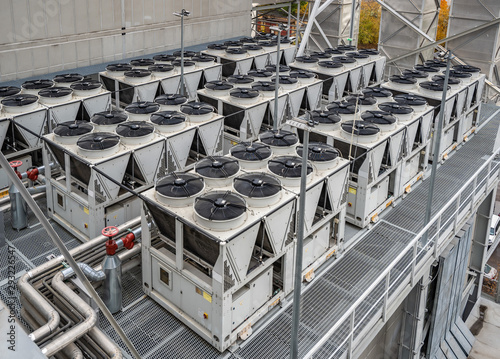
Mechanism: Uses ambient air to cool the
refrigerant. It looks like a large car radiator with big fans.
Pros: No water treatment needed; no cooling
tower required; lower installation cost.
Cons: Consumes more electricity (less efficient);
noisy; limited capacity; performs poorly in very high ambient temperatures.
Best for: Medium buildings, places with water
scarcity.
Water-Cooled Chiller:
Mechanism: Uses water from a Cooling
Tower to cool the refrigerant. The heat is transferred to the water, which
flows to the tower and is released into the air as steam.
Pros: Highly energy efficient;
longer lifespan; quieter operation (because the noisy fans are on the tower,
often on the roof).
Cons: Higher installation cost; requires a
Cooling Tower; requires complex water treatment chemistry to prevent
scaling/corrosion.
Best for: High-rise buildings, large campuses,
data centers.
2. By Compressor Type (The heart of the chiller)
Scroll Chillers: Small capacity; usually
Air-Cooled. Used for small commercial processes.
Screw Chillers: Medium to Large capacity; very
reliable and efficient. Common in commercial buildings.
Centrifugal Chillers: Very High capacity; used
for massive cooling loads (like airports or skyscrapers). They operate at high
speeds.
Reciprocating (Piston) Chillers: Older
technology; used for smaller loads or industrial processes
3. Key Components of a Chilled Water HVAC
System
A standard Central Plant (Chiller System)
consists of four main loops:
1. The Chiller Loop (Evaporator Side):
* The chiller cools
the water down to approx. 6°C (42.8°F)
* This water is pumped
to the building.
2. The Distribution Loop (Pumps):
Primary Pumps: Push water through the chiller.
Secondary Pumps: Push water up the
building to the floors.
3. The Air Side (Terminal Units):
AHU (Air Handling Unit): A large
box containing a fan, a filter, and a cooling coil. It takes in fresh air,
mixes it with return air, cools it over the coil, and pushes it into ducts.
FCU (Fan Coil Unit): A smaller
version of an AHU, usually located above a false ceiling in a specific room to
cool that space only.
4. The Rejection Loop (Condenser Side -
Water Cooled Only)
* Warm water leaves
the chiller and goes to the **Cooling Tower
* The Cooling Tower
sprays the water into the air to cool it down.
* A Condenser Water
Pump cycles the water back to the chiller.
4. HVAC System Components Detail
AHU (Air Handling Unit)
Filtering: Removes dust and pollen (Pre-filters,
Bag filters, HEPA filters).
Cooling/Heating:Coils that adjust the air
temperature.
Humidification/Dehumidification: Adds or removes
moisture.
Air Movement: A large centrifugal fan blows air
through the ductwork.
Cooling Tower
Function: Evaporative heat rejection device. It
cools the hot water coming from the chiller.
Types
Open Circuit:Water is exposed to air
directly.
Closed Circuit: Water stays inside pipes
(cleaner).
Fill Media:Plastic sheets inside the tower that
increase surface area for evaporation.
VRF / VRV Systems (Variable Refrigerant Flow)
* A modern alternative to chillers
for medium buildings.
* It uses refrigerant piping
directly to multiple indoor units (like split ACs) but from one large outdoor
condenser unit.
* It allows simultaneous heating and
cooling in different zones (heat recovery).
5. Maintenance & AMC Focus (Chillers &
HVAC)
When maintaining these systems (under an AMC),
the focus areas are critical:
Chiller Maintenance
1. Tube Cleaning: In water-cooled
chillers, the condenser tubes collect scale (mineral deposits). They must be
"brushed" or chemically cleaned annually.
2. Refrigerant: Checking for leaks and
ensuring superheat/sub cooling values are correct.
3. Oil Analysis: Checking the compressor
oil for metal shavings (wear) or acidity.
4. VFDs (Variable Frequency Drives):
Ensuring the chiller modulates its speed based on load to save energy.
AHU/FCU Maintenance
1. Filter Washing:*Dirty filters block
airflow and waste energy. This is usually done monthly.
2. Coil Cleaning: Cooling coils get
clogged with dust and mold, reducing heat transfer. Chemical cleaning is done
quarterly/annually.
3. Belt Tensioning: The fan belts can snap
or slip; they need tightening and replacement.
Cooling Tower Maintenance
1. Water Treatment: Dosing chemicals to
prevent algae growth and Legionella bacteria.
2. Descaling: Removing mineral
buildup from the fill media and basin.
|
Summary Table |
|
Feature |
Air-Cooled Chiller System |
Water-Cooled Chiller System |
|
Heat Rejection coilS |
Fans blowing air over
|
Water pumped to
Cooling Tower |
|
Efficiency
(COP) |
Lower
(2.5 - 3.5) |
Higher (5.0 - 7.0+) | |
|
Water Usage treatment |
Minimal (for cleaning
only) |
High (evaporation +
chemical
|
|
Installation
Cost |
Lower |
Higher |
|
Space Requirement airflow |
Outdoor (requires open
|
Indoor (Chiller) +
Outdoor (Tower) |
|
Noise
Level |
Higher (compressor + fan noise) |
Lower (Indoor unit is quiet) | |

AL BAYT 7 Tower Ground Floor Unit 3, P, Box: 12613
King Faisal bin Abdulaziz Al Saud Road Al Murabba Riyadh KSA.
Branches
Tadban/Hyderabad India,
2501 CHATHAM RD STE R SPRINGFIELD IL 62704 USA,
As Sawmhan / Barka / South Al Batinah Governorate Oman.

0535398660
0561657087
0115126975

Saturday -Thursday (9:00 AM - 6:00 PM)
Friday: Off